Law & Technology
From AI to SI: two days after Washington’s rename, a technology lawyer published one of the first books for the new era
As the US executive branch swaps “Artificial Intelligence” for “Super Intelligence,” Super Intelligence (SI) for Lawyers 2026 argues that the profession’s real test has not changed: proving that what AI produces is real, protected and owned.
On September 29, the President signed an executive order directing federal departments and agencies to stop using the terms “Artificial Intelligence” and “AI” in official and non-statutory documents, and to use “Super Intelligence” and “SI” instead. Officials were given 60 days to draft legislative language defining the new terms in federal law.
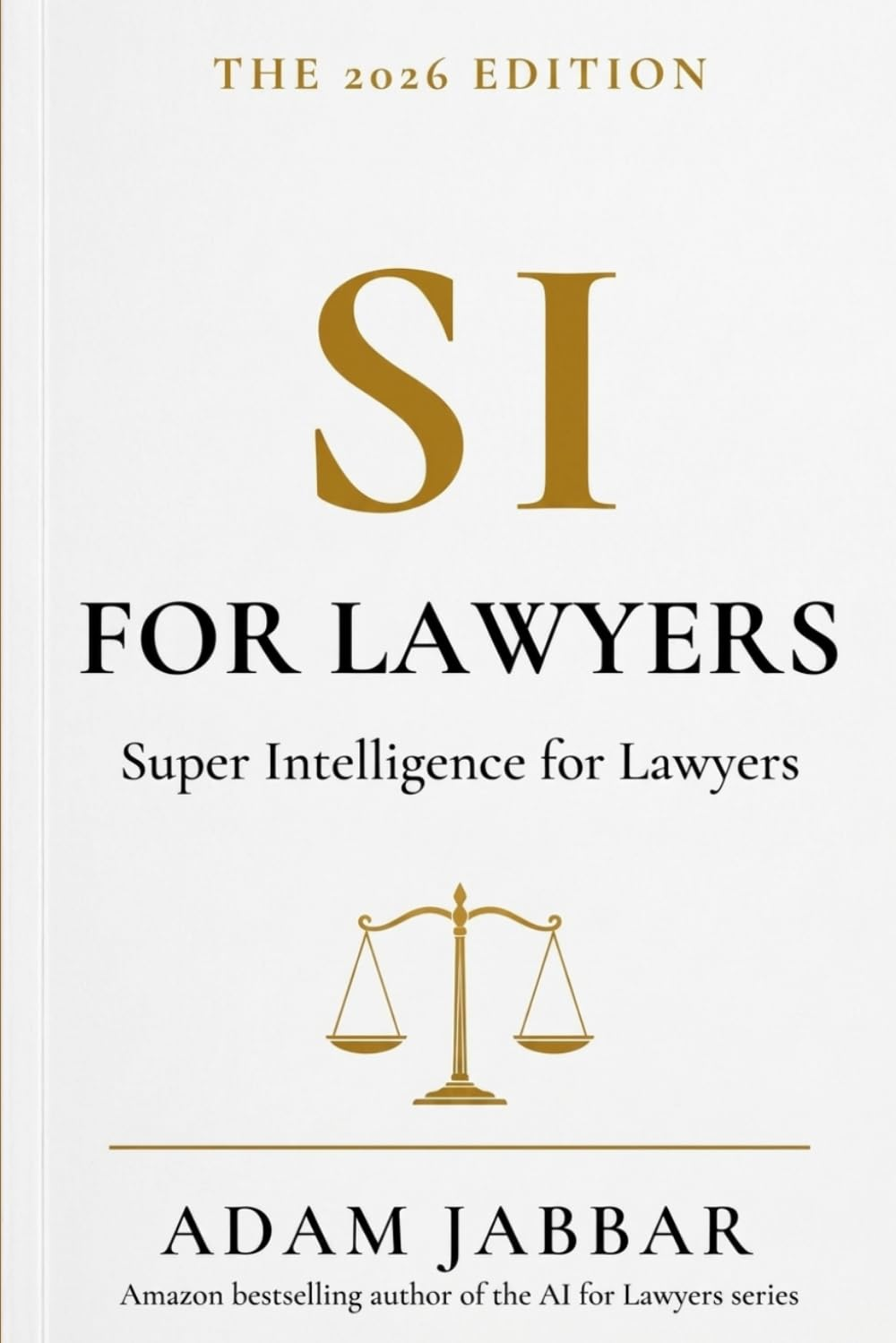
Two days later, Adam Jabbar, a technology lawyer and the Amazon bestselling author of the AI for Lawyers series, published Super Intelligence (SI) for Lawyers 2026. At 314 pages, it is among the first books for the legal profession to be built around the new terminology.
Its central message is deliberately unglamorous.
“Washington changed the name. It did not change a lawyer’s duties.”Adam Jabbar
A name change, not a rule change
The order governs vocabulary inside the federal executive branch. It does not amend statutes, court rules or the ethics opinions that already regulate how lawyers use the technology, from the American Bar Association’s Formal Opinion 512 to the growing number of state bar opinions and court rules.
That distinction matters because the courts have not been patient. In March 2026, the U.S. Court of Appeals for the Sixth Circuit ordered two attorneys to pay $15,000 each, plus the other side’s appellate fees, over fabricated citations in Whiting v. City of Athens. In April, the Nebraska Supreme Court temporarily suspended an attorney after 57 of 63 citations in a brief proved defective. And on September 30, California enacted SB 574, which from January 2027 will require attorneys to verify AI output and every citation they file.
Real, protected, owned
The book frames responsible use around three questions that, in Jabbar’s view, decide whether any use of the technology is defensible, whatever it happens to be called.
Can you prove it is real, with every citation, quotation and figure checked against its source by a person? Can you prove it is protected, with client information kept only in tools that are contractually barred from training on it? And can you prove who owns it, with a named lawyer signing off and answering for every word?
“The firms that will lead are not the ones using the most AI. They are the ones that can defend every output.”Adam Jabbar
Much of the book is practical. It walks lawyers through Claude and ChatGPT for drafting and document review, connecting the tools safely to email and research systems, a prompting method it calls CRAFT-L, and a verification playbook designed to catch fabricated cases and misquotations before a judge does. It also addresses privilege and the 2026 court rulings on AI.
From “ChatGPT” to “SI”
Jabbar has written about the technology for the profession since March 2023, when he published ChatGPT for Lawyers: 101 Practical Prompts, one of the early practical guides to generative AI written for lawyers. The series has since grown to six books, read by legal professionals in more than 30 countries.
Alongside the books, his AI for Lawyers Academy offers free, browser-based tools, including a citation checker, a law firm AI policy generator and a state-by-state map of bar guidance, as well as a free course with a certificate of completion. He is also President of the International AI & Law Forum, a global community of lawyers, judges, academics and students.
For lawyers, the new name may take some getting used to. The standard, Jabbar argues, is already familiar.
Super Intelligence (SI) for Lawyers 2026
The SI guide to Claude, ChatGPT, legal prompts, verification and ethics.
Media enquiries, interviews and review copies: contact@aiforlawyersacademy.com. Sources: White House fact sheet; Sixth Circuit opinion; Holland & Knight on SB 574.